MEng · Final Year Research Project · 2021

Flame Self-Interactions in Turbulent Boundary Layer Flashback of Premixed Hydrogen-Rich Combustion

A Direct Numerical Simulation (DNS) study identifying how flame topology behaves near a combustor wall during hydrogen flashback — supervised by Dr Umair Ahmed, Newcastle University.

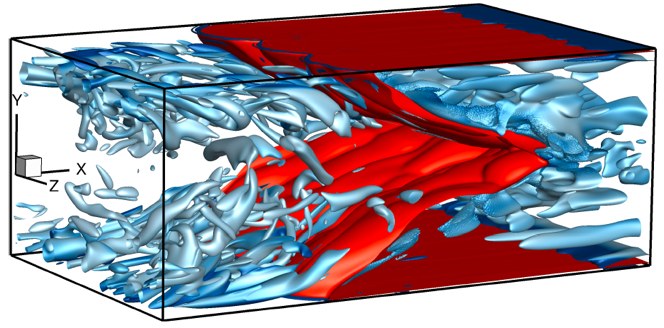
Instantaneous DNS iso-surfaces of temperature (red, 1700K) and vorticity magnitude (blue) in the flashback region of the turbulent channel flow, isometric view
Isometric view
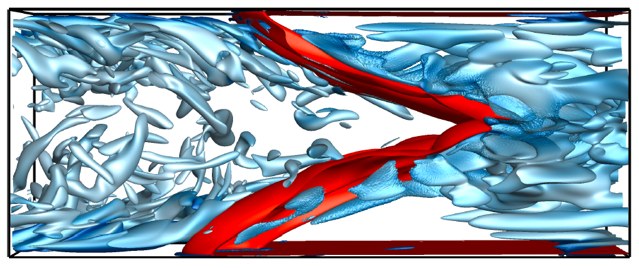
Instantaneous DNS iso-surfaces of temperature (red, 1700K) and vorticity magnitude (blue) in the flashback region of the turbulent channel flow, side view
Side view

Instantaneous DNS iso-surfaces of the flame (red, 1700K) and turbulent vorticity (blue) inside the flashback region — the raw simulation output this entire study was built on.
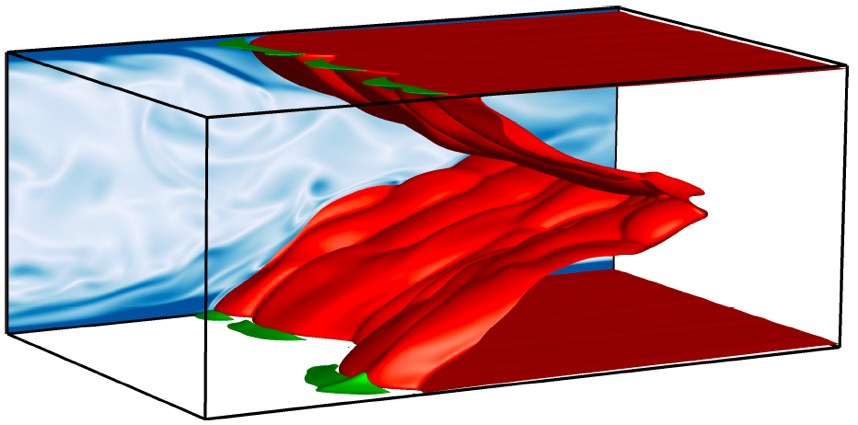
DNS visualization near the top wall showing wavy blue turbulent flame surface structures and green iso-surfaces marking regions of reverse (upstream-propagating) flow immediately ahead of each flame bulge
Near-wall view: the green iso-surfaces mark localised regions of negative (upstream-propagating) velocity immediately ahead of each flame bulge — a key mechanism enabling flashback right at the wall.
The Question

How does the presence of a wall boundary influence the topology and frequency of flame self-interaction (FSI) events during turbulent boundary-layer flashback of hydrogen-rich premixed combustion?

Why It Matters

Hydrogen is one of the leading clean fuels for future power generation and aviation propulsion, but its high reactivity and low quenching distance make it far more prone to boundary-layer flashback — the uncontrolled upstream propagation of a flame — than conventional hydrocarbon fuels. Flashback is a critical failure mode for hydrogen combustors, and accurately modelling it requires a detailed understanding of how flame topology behaves right at the wall, where current turbulence models are weakest.

What I Did
  • Interrogated a ~0.4 billion grid-point Direct Numerical Simulation (DNS) database of hydrogen-air boundary-layer flashback
  • Applied critical-point theory to classify flame self-interaction topologies via the eigenvalues of the Hessian of the reaction progress variable
  • Conducted statistical analysis — probability density functions, histograms, and curvature statistics — across six wall-normal distances through the channel flow
  • First study to examine flame self-interaction topology distributions specifically within hydrogen-rich boundary-layer flashback
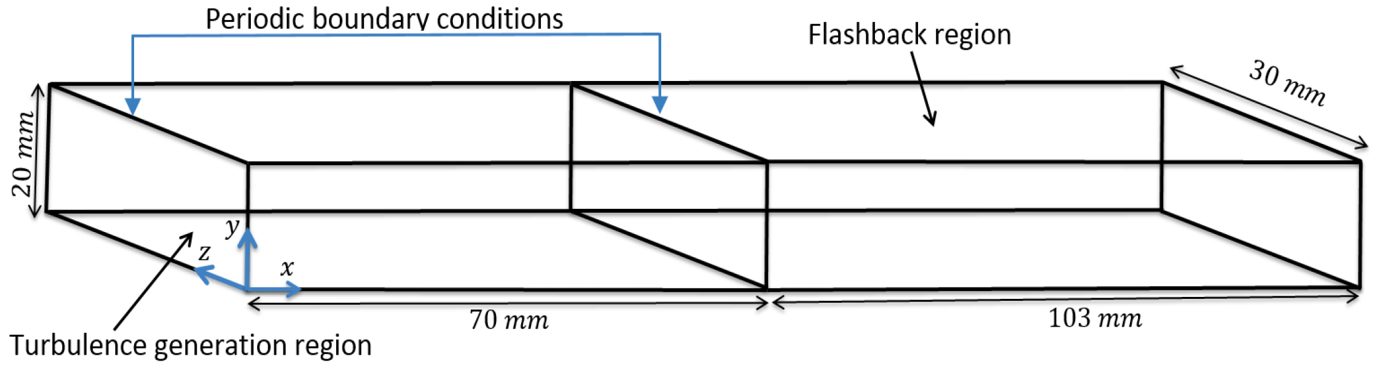
DNS computational domain schematic showing the turbulence generation region and flashback region of the channel flow
Computational domain used in the DNS: a turbulence generation region feeds into the flashback region where the premixed hydrogen flame propagates upstream.
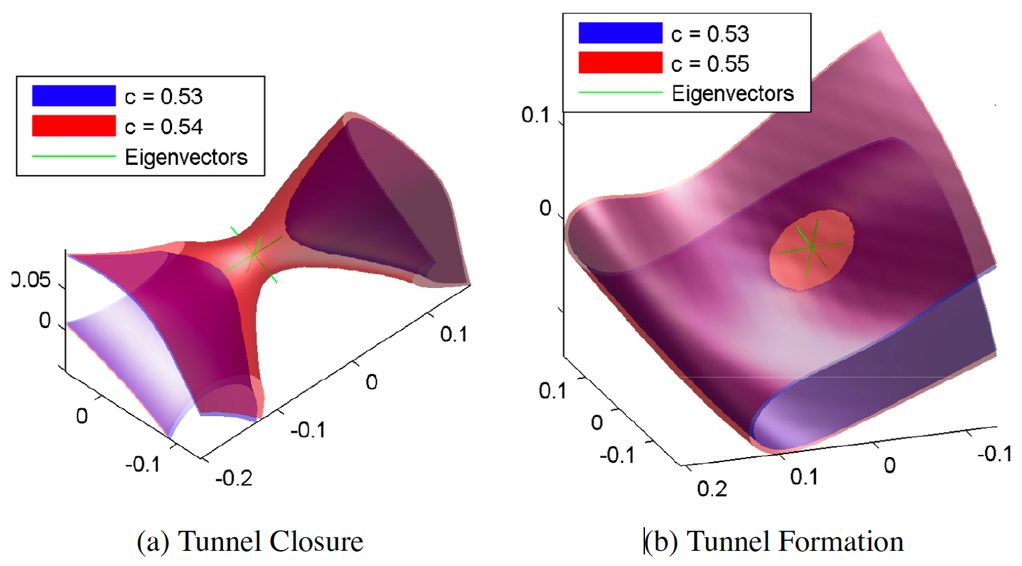
Two 3D flame surface renderings from the DNS data showing a Tunnel Closure topology and a Tunnel Formation topology
Two of the flame self-interaction topologies extracted directly from the DNS data: (a) Tunnel Closure, (b) Tunnel Formation — the dominant topology found in this study.
Key Result
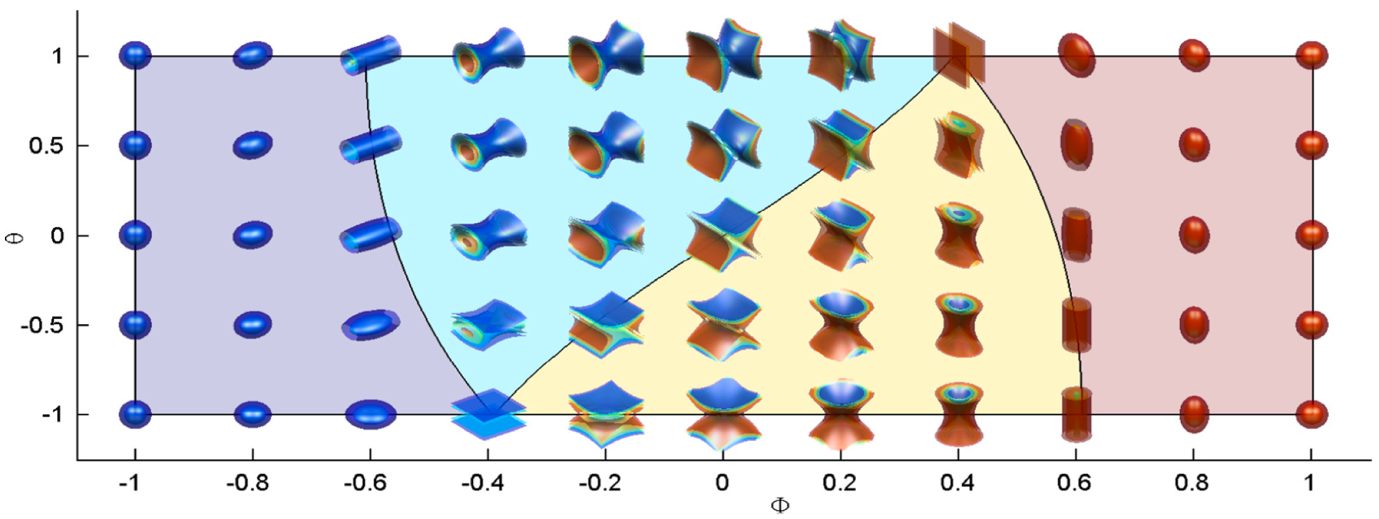
Shape-factor classification space showing how the four flame self-interaction topology types (Burnt Gas Pocket, Tunnel Formation, Tunnel Closure, Unburnt Gas Pocket) map onto combinations of Hessian eigenvalue signs
The classification space used to identify FSI topologies from the sign combinations of the Hessian eigenvalues — spanning Burnt Gas Pockets, Tunnel Formation, Tunnel Closure, and Unburnt Gas Pockets.

Tunnel Formation topologies dominate, accounting for over 50% of all flame self-interaction events at every distance from the wall — with the wall boundary shown to have a significant influence on flame surface geometry and the overall turbulent burning rate.

Impact / What's Next

The findings have direct implications for flame-surface-based combustion models used in industrial combustor design. This project also marked an early engagement with hydrogen combustion physics — a thread that carried directly into the DPhil's later work on thermal solutions for liquid hydrogen jet engines.

← Back to all projects