Having validated a CFD model of the heat exchanger geometry, can that model be used to find a genuinely better design — and can a novel variant of the geometry outperform the conventional one?
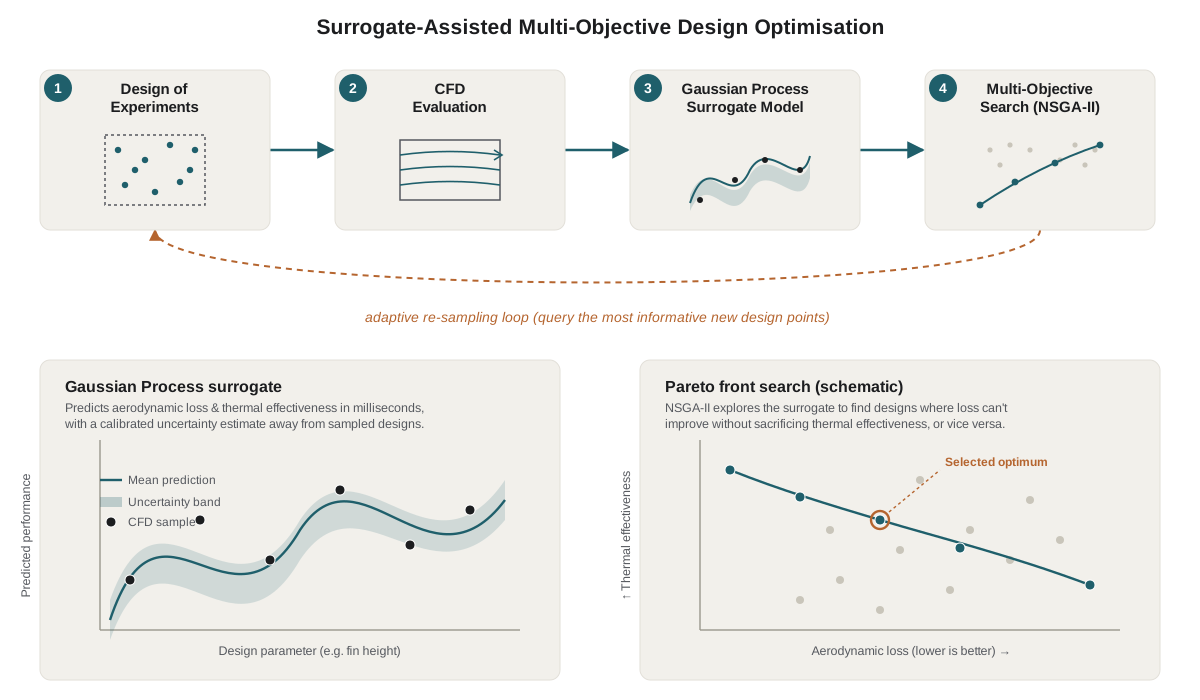
Every CFD evaluation of a candidate geometry takes hours to run, which makes exhaustively searching a multi-dimensional design space computationally impractical. Surrogate modelling solves this: a design-of-experiments campaign samples a manageable number of CFD evaluations, from which a statistical model can predict performance elsewhere in the design space in milliseconds — making it feasible to search thousands of candidate geometries and identify genuine performance trade-offs, not just the handful of designs that could ever be run directly in CFD.
- Ran an adaptively-sampled design-of-experiments campaign over the conventional surface heat exchanger geometry, sampling geometric parameters and evaluating aerodynamic loss and thermal effectiveness for each design point using the validated CFD model
- Built Gaussian Process surrogate models from the CFD results, reducing geometry evaluation time from hours to milliseconds and enabling exploration of design points far beyond what direct CFD could practically cover
- Used the surrogate models to identify Pareto-optimal geometries via Bayesian Optimisation (Expected Improvement acquisition) and an NSGA-II multi-objective search, trading aerodynamic loss against thermal effectiveness across representative installation flow conditions
- Quantified surrogate robustness with a custom global sensitivity analysis (Saltelli/Jansen total-order Sobol indices) and bootstrap confidence intervals, rather than trusting a single point-estimate surrogate fit
- Repeated the same design-of-experiments and surrogate-modelling process for a novel variant of the surface heat exchanger geometry, currently withheld from public disclosure pending a planned patent application
This pipeline was built in MATLAB (Statistics & Machine Learning Toolbox, Global Optimization Toolbox); I am currently porting the core surrogate/optimisation loop to the Python ecosystem (GPyTorch, BoTorch).
Conventional Geometry Results — Pending Publication
The Pareto front and optimum design for the conventional geometry are held back from public disclosure until published through official channels (the DPhil thesis or an ASME Turbo Expo paper). This figure will be added once published.
Novel Geometry Results — Patent & Publication Pending
The novel geometry's performance results are held back for the same reason, plus a planned patent application. This figure will be added once published and cleared for disclosure.
Numerical analysis of the optimised design predicts over 200% performance increase over designs currently used commercially. A patent application is planned for the novel geometry once further supporting performance data is available.
With optimised conventional and novel geometries identified, the final stage of the DPhil — not yet complete — takes both designs and represents their performance improvement at the level of a full liquid hydrogen jet engine system, to quantify the engine efficiency gains this research actually enables.