Which honeycomb sandwich panel design parameters most reduce the ratio of average density to flexural rigidity — i.e. give the most stiffness for the least mass — under three-point bending?
Honeycomb sandwich panels are used wherever mass must be minimised without sacrificing strength or stiffness — structural supports in aircraft and rockets being the textbook case, since every kilogram saved directly improves fuel efficiency and payload. Finding which geometric parameters actually move the needle (versus which are second-order) is what turns a structural design from "adequate" into "optimised."
- Modelled a quarter-symmetry honeycomb sandwich panel in ANSYS SpaceClaim, parametrically driven by a Python script so geometry could be swept automatically
- Set up a three-point bend FEA load case (aluminium honeycomb core, composite skins, stainless steel support/load pins) matching physically manufactured test specimens
- Used a broader sensitivity sweep to identify the three most influential parameters — core thickness, ribbon thickness, and cell size — then varied each independently in ANSYS while holding the rest constant
- Cross-checked FEA stiffness and failure-mode predictions (buckling, wrinkling, core collapse, shear failure, skin yield) against classical sandwich-panel theory (Gibson & Ashby, Masters & Evans, Gediac formulations)
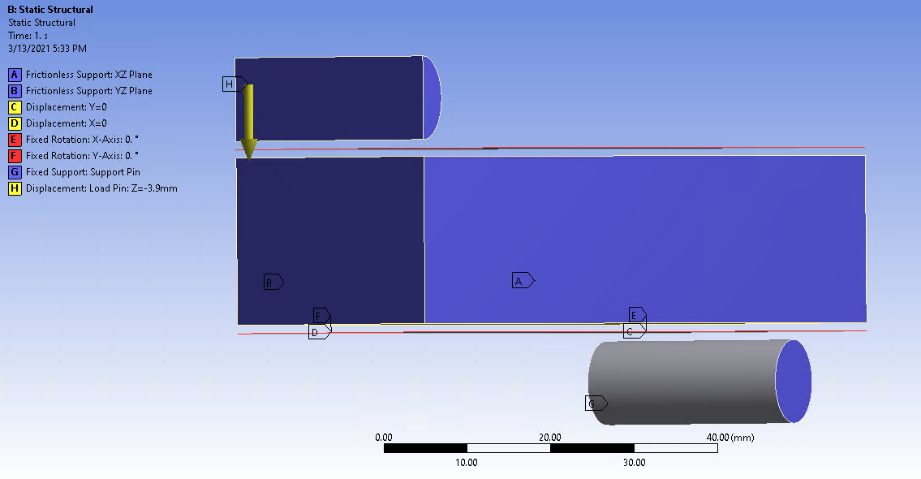
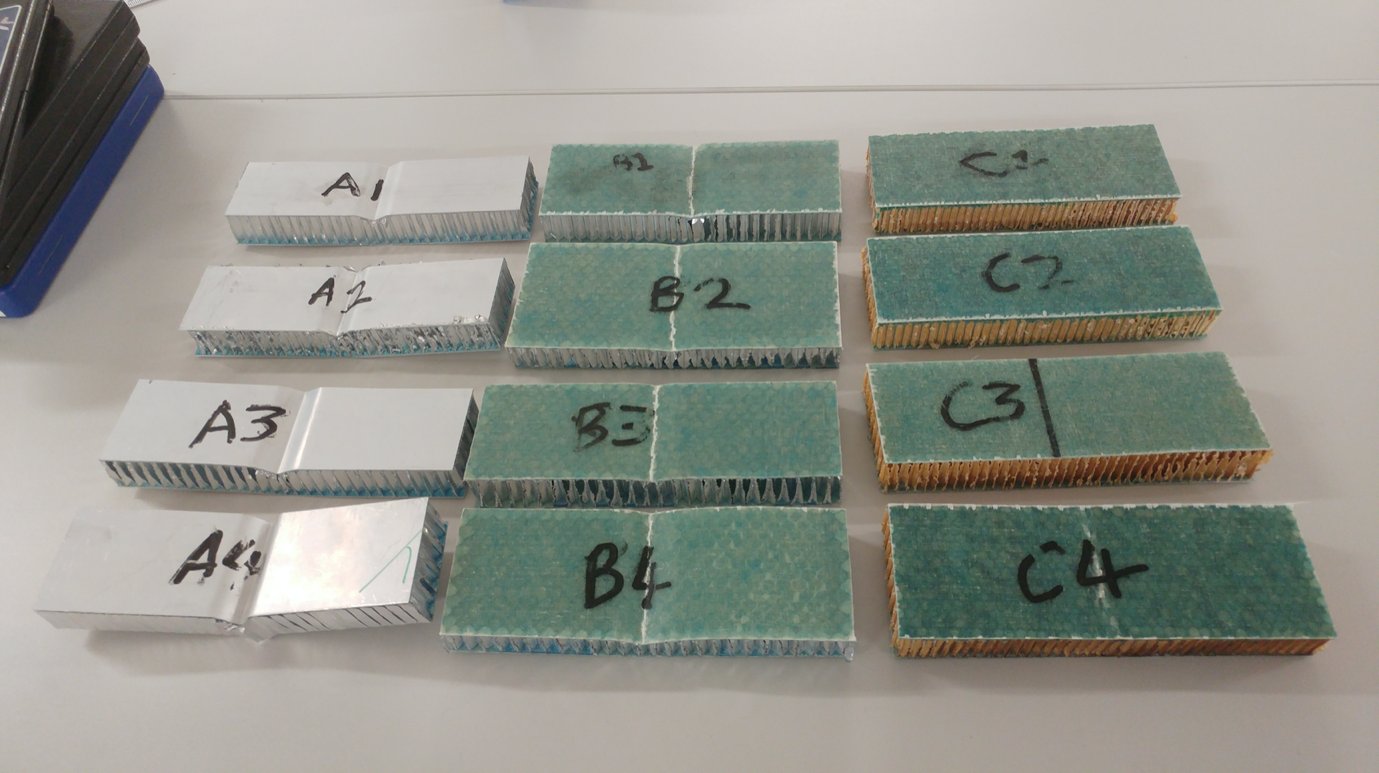
| Parameter swept | Range | Effect on density/rigidity ratio |
|---|---|---|
| Core thickness | 10 → 60mm | 1.98 → 0.23 kg/Nm (−88%) |
| Ribbon thickness | 0.03 → 0.08mm | 2.14 → 1.33 kg/Nm (−38%) |
| Cell size | 1 → 6mm | 1.13 → 2.11 kg/Nm (+87%, i.e. smaller is better) |
Core thickness was by far the most influential parameter — increasing it from 10mm to 60mm cut the density-to-rigidity ratio by 88%, far outweighing the effect of ribbon thickness or cell size.
Identifying core thickness as the dominant lever (rather than assuming all three parameters mattered equally) is exactly the kind of design insight that makes structural optimisation tractable — it tells a designer where to spend their weight budget for maximum stiffness return. This same mass-versus-performance trade-off, and the discipline of isolating which parameter actually drives it, carries directly into the DPhil's heat exchanger geometry optimisation work.